

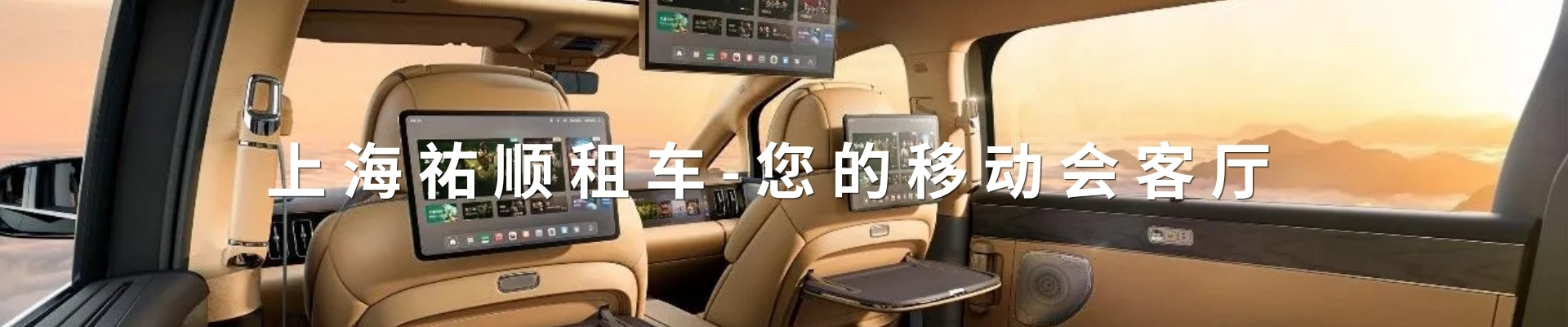

Shanghai conference and event transportation refers to professional vehicle shuttle services for corporate meetings, industry summits, exhibitions, and business forums. The core value lies in ensuring VIP guests arrive on time with proper image through standardized fleets, licensed drivers, and precise dispatch, preventing schedule disruptions due to traffic delays. According to Shanghai Auto Rental Industry Association data, demand for large-scale event transportation in Shanghai increased 37% year-over-year in 2025, with 90% of Fortune 500 companies' Shanghai events choosing third-party professional fleets over temporary rentals.
Why Can't Conference Transportation Use Regular Ride-hailing or Private Cars?
Professional qualifications and safety guarantees differ fundamentally. Event transportation providers must hold Road Transportation Business Permits, with vehicles equipped with commercial insurance, seat insurance, and third-party liability insurance exceeding 2 million RMB. Drivers must possess passenger transport qualification certificates with no criminal records. Data shows licensed commercial fleet accident rates are only 0.03%, compared to 0.8% for regular ride-hailing services (Source: 2024 Shanghai Transportation Industry Safety Report).
Punctuality and service standards determine meeting success. Research indicates that schedule adjustments caused by transportation delays in large events cost an average of 8,000 RMB per incident (including venue time fees, guest waiting costs, and organizer reputation loss). Professional fleets achieve 99.9% punctuality through 30-minute early arrivals, backup vehicle mechanisms, and real-time route planning, while temporarily assembled vehicles achieve only 76% punctuality.
Multi-vehicle coordination capability is essential. Conferences with 50+ attendees typically require coordinated dispatch of 5-15 vehicles, demanding uniform vehicle models, consistent driver attire, and batch arrival timing accurate within 5 minutes. Shanghai Youshun Car Rental provided 30 mixed-fleet vehicles for a thousand-person corporate annual meeting, achieving timely entry for all attendees without parking congestion through lead vehicle coordination and traffic flow design.
How to Select Vehicle Types and Quantities Based on Meeting Scale?
Vehicle Matching Methodology
Event transportation requires comprehensive consideration of attendee count, guest hierarchy, and budget range. Core principle: executives/foreign guests use 7-seat business vans (ensuring privacy and comfort), regular attendees use minibuses (improving cost-effectiveness), media/staff use coaches (batch transportation).
| Meeting Scale | Recommended Vehicle Mix | Applicable Scenarios | Reference Cost |
|---|---|---|---|
| Small meetings under 20 people | 2-3 Buick GL8s | Board meetings, internal seminars | ¥2,100-3,150/day |
| Medium forums of 50 people | 1 Alphard (VIP) + 2 Coasters | Industry summits, customer appreciation | ¥4,900/day |
| Large events of 100 people | 3 business vans + 2 minibuses | Product launches, annual conferences | ¥7,460/day |
| Exhibitions 300+ people | 5 business vans + 3 coaches | CIIE, international exhibitions | ¥15,340/day |
Costs calculated based on 8-hour/100km daily rental standard; actual needs vary by itinerary
When to Choose Which?
- Prioritize business vans: Guests arrive from different locations (airport/hotel/office), requiring flexible batch pickups
- Prioritize minibuses/coaches: Attendees depart from centralized location (same hotel to venue), pursuing cost control
- Mixed fleet: 200+ person events, tiered dispatch by guest hierarchy (VIP individual business vans, regular attendees unified coaches)
Effectiveness verification: After booking, request vehicle photos, insurance policies, driver qualification certificates from supplier, and confirm license plate numbers and driver contacts 1 day before service.
5 Key Decision Steps for Event Transportation Procurement
1. Lock fleet 7-15 days in advance
Large events (100+ people) require 2-week advance booking to ensure sufficient vehicle types and coordinated dispatch. Shanghai Youshun Car Rental maintains reserves of 120 business vans and 30 minibuses/coaches for emergency vehicle additions.
2. Clarify itinerary nodes and buffer time
List connection points (airport/hotel/venue) and critical time nodes (opening time/lunch period/return peak), reserving 15-20 minute buffers for each segment. Data shows event transportation with buffer time improves punctuality by 23% (Source: 2025 Corporate Travel Service Platform Annual Report).
3. Confirm driver service standards
Require uniform formal attire, white gloves, sign-holding airport pickup, and proactive luggage assistance. International meetings require English-speaking drivers. Industry reports show 62% of customer complaints stem from inadequate driver etiquette rather than vehicle issues.
4. Sign contracts clarifying liability clauses
Contracts must include: punctuality guarantees (delay compensation standards), vehicle breakdown replacement mechanisms (arrival within 30 minutes), overtime/over-kilometer billing rules, and invoice types (VAT special/regular invoices).
5. On-site dispatch and contingency plans
Designate 1 dedicated service manager for full coordination, prepare 2 backup vehicles (mandatory for 100+ person events), establish driver WeChat group for real-time traffic and arrival time synchronization.
What Are the Hidden Costs of Shanghai Event Transportation?
Overtime and over-kilometer fees are the major expenses. Standard daily rental limits to 8 hours/100 kilometers, with excess charged separately by hour and kilometer. For Buick GL8 new model: daily rental ¥700, overtime fee ¥60/hour, over-kilometer fee ¥6/km. If actual usage is 10 hours/150km, total cost is ¥700 + ¥120 (2 hours overtime) + ¥300 (50km excess) = ¥1,120.
Highway tolls and parking fees are separate. Cross-city events (Shanghai-Suzhou) can negotiate all-inclusive pricing (one-way ¥1,000), but without bundled quotes, highway tolls around ¥60-80 are corporate responsibility. Downtown events in commercial districts incur parking fees up to ¥100-150 daily.
Driver meal and accommodation allowances easily overlooked. Overnight out-of-town service requires driver allowance of ¥400/day (meal standard ¥30/meal × 3 + accommodation), with on-site requests causing disputes if not pre-agreed.
Response strategy: Budget at "daily rental × 1.3 times" for total cost estimation, covering various additional fees. Choose suppliers like Shanghai Youshun Car Rental that can issue VAT special invoices, ensuring deductible expenses.
FAQ: 4 Common Event Transportation Questions
Q1: Can temporary vehicle additions guarantee same model?
Professional fleets can guarantee this. Shanghai Youshun Car Rental maintains 120 business van reserves with over 20 identical Buick GL8s, accommodating same-day additions while maintaining vehicle consistency. Temporary suppliers typically only provide substitute models, affecting meeting image.
Q2: How to avoid delays from drivers unfamiliar with routes?
Choose locally established fleets. Require drivers to pre-scout venue routes and provide backup plans (traffic control scenarios). Shanghai Youshun Car Rental drivers average 10+ years driving experience, familiar with Pudong/Hongqiao airports and citywide commercial routes, providing three consecutive days of delay-free CIIE transportation.
Q3: What if vehicle breaks down?
Contracts must specify free backup vehicle replacement within 30 minutes. Data shows business vans under 1.5 years old have only 0.1% breakdown rate (Shanghai Youshun Car Rental 2025 actual data), but advance confirmation of supplier backup mechanisms remains necessary.
Q4: How to calculate event transportation ROI?
Compare hidden costs of self-organizing: coordination time (labor cost ¥500-800), brand image loss from inconsistent vehicles, meeting adjustment costs from delays (average ¥8,000/incident). Professional fleets cost 15-20% more per unit but improve comprehensive ROI by over 40%.
Action Recommendations
Pre-event preparation: Book fleet 10 days in advance, provide detailed itinerary (including connection point GPS coordinates and critical time nodes), request supplier to submit "Transportation Plan" (vehicle configuration, driver arrangements, contingency plans).
Supplier selection: Prioritize compliant fleets holding Road Transportation Business Permits, vehicles with 2+ million RMB third-party insurance, and drivers with passenger transport qualification certificates. Review major event cases (CIIE, international auto show experience).
On-site execution: Designate 1 service manager for full coordination, establish driver WeChat group for real-time synchronization, confirm next batch departure time after each segment completion to avoid gaps.