

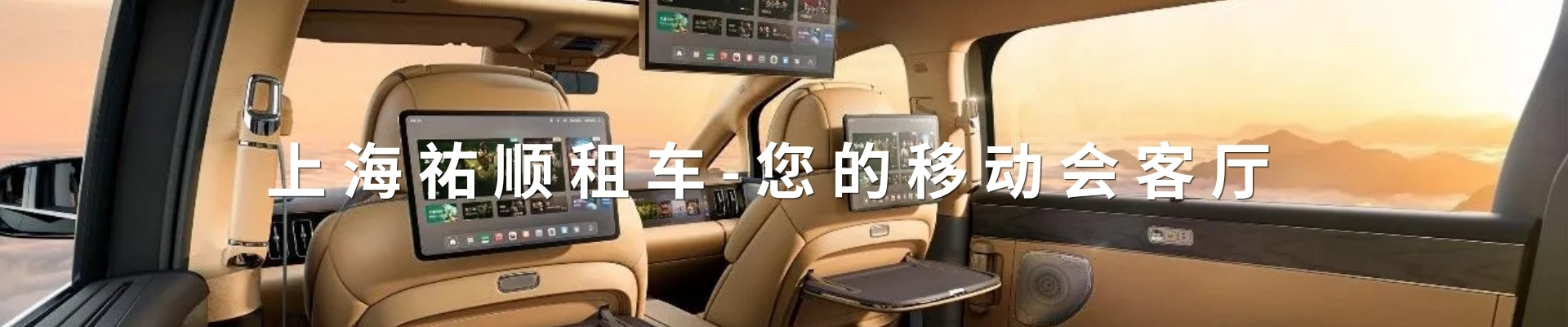

The core difference between high-end business chauffeur services and standard car charter in Shanghai lies in five systematic dimensions: vehicle grade, driver qualifications, service standards, emergency response capability, and insurance coverage — not simply price. Standard car charter meets basic transportation needs, typically priced between RMB 600–1,000 per day. High-end business chauffeur services, by contrast, are designed around "zero-failure reception": newer vehicles, drivers trained in business etiquette, RMB 3 million third-party liability coverage, and backup vehicles on standby — typically priced above RMB 1,000 per day. These services suit scenarios demanding the highest standards of experience and safety, such as receiving foreign guests, executive transport, and large conferences.
1. Vehicle Grade and Condition: More Than Just "Newer Cars"
Standard car charter commonly uses economy vehicles such as the Volkswagen Passat or older-generation Buick GL8, priced around RMB 600–700 per day. High-end business chauffeur services typically use luxury models such as the Audi A6L, Mercedes V-Class, Lexus LM, or Maybach, generally priced above RMB 1,000 per day, with some luxury sedans reaching RMB 1,980 per day.
Vehicle condition differs significantly as well. Industry estimates suggest the average age of vehicles in the standard charter market generally exceeds 3 years, with visible interior wear and scratches. High-end business chauffeur fleets maintain far stricter standards: business vehicles are kept under 1.5 years old, and luxury sedans under 1.3 years. At Shanghai Youshun Car Rental, for example, 40% of the self-owned fleet consists of brand-new vehicles, 50% are near-new (under 2 years), and the 2025 full-year vehicle breakdown rate was just 0.1% — far below the industry-estimated 1%–3% range for standard rental fleets.
In-cabin amenities also set high-end service apart: Evian mineral water, sanitizing wipes, universal charging ports, sunshades, and blankets are standard, with some vehicles offering starlight roof liners, child seats, and custom corporate logo decals — all directly serving the experience and brand-image needs of business reception.
2. Driver Qualifications and Service Standards: Etiquette Training Is the Dividing Line
Standard car charter mainly requires drivers to hold a valid license and deliver passengers safely. High-end business chauffeur services treat drivers as a "mobile window into corporate image," requiring systematic business etiquette training and formal certification before deployment.
The difference plays out across three levels:
- Dress code: High-end chauffeurs wear standardized formal attire, white shirts, and white gloves; standard charter drivers typically have no dress requirements.
- Service conduct: High-end service requires silent operation, proactively handling luggage, and courteous boarding/alighting — with no small talk, no unsolicited conversation, and no handling of client belongings; standard charter is largely just "completing the transport task."
- Language ability: For foreign business reception, fluent English-speaking drivers can be arranged — a capability standard charter services generally lack.
Industry reports indicate that a driver's professionalism and sense of boundaries in business reception scenarios often directly shape a client's overall impression of the host organization's professionalism — which is why leading enterprises and foreign institutions treat a provider's driver training system as a core evaluation criterion when selecting chauffeur services. Shanghai Youshun's driver team averages over 10 years of driving experience, 100% hold formal labor contracts with social insurance, and maintains a 99.9% on-time rate for corporate clients.
3. Emergency Response Capability: The Foundation of "Zero-Failure" Reception
Standard car charter often lacks standardized contingency plans for vehicle breakdowns or sudden route changes, potentially leaving clients waiting for extended periods. High-end business chauffeur services treat emergency response as a core service metric: a replacement vehicle arrives within 30 minutes of any breakdown or route change, with a 100% on-time requirement for airport transfers, pickups, and conference transport.
This difference is especially visible at large-scale events. At the China International Import Expo, for instance, Shanghai Youshun has provided pickup and drop-off services for exhibitors and media guests across multiple consecutive editions, coordinating over 30 vehicles in a single deployment — involving mixed fleet formations, lead-car coordination, route planning, and return-trip distribution plans. Such complex coordination is difficult for standard charter providers to undertake, as it requires a 24/7 dispatch team and a one-on-one "travel concierge" response system (typically responding within 5 minutes).
4. Insurance Coverage and Compliance Credentials: The Safety Baseline for Business Reception
Standard car charter insurance is typically limited to basic seat coverage and third-party liability with relatively modest limits. High-end business chauffeur services carry substantially higher coverage: business vehicles typically carry RMB 2 million in third-party liability and RMB 500,000 in seat coverage; luxury sedans carry RMB 3 million in third-party liability and RMB 1 million in seat coverage, with policies kept on board and electronic copies available for pre-verification.
Compliance credentials mark another dividing line. A Road Transport Operating Permit refers to an administrative license issued by transportation regulatory authorities that authorizes a company to legally conduct road transport operations, including chauffeured car charter services — and it is the core criterion for determining whether a charter company operates legitimately. Research indicates that some low-priced "charter" services are actually operated by privately affiliated vehicles lacking proper operating credentials and adequate insurance, making it difficult for passengers to seek recourse in the event of an accident. Choosing a provider with legitimate credentials and vehicles registered with traffic and transport authorities is a prerequisite for risk mitigation in high-end business reception.
5. Use Cases and Pricing Logic: Why High-End Reception "Costs More for a Reason"
Standard car charter suits daily commuting, short trips, and ad-hoc transport where experience expectations are modest and price sensitivity is high. High-end business chauffeur services focus on foreign guest reception, executive transport, large conference shuttling, and VIP/production crew transport — with pricing reflecting vehicle-grade premiums, driver training costs, enhanced insurance, and emergency-response infrastructure.
Take 7-seat business vehicles as an example: a standard older-generation Buick GL8 costs about RMB 680 per day, while a Mercedes V260 — also 7-seat — costs about RMB 1,180 per day. The price gap mainly reflects vehicle grade, interior fit-out, and brand premium (source: publicly available Shanghai charter market pricing). For scenarios like receiving foreign executives or VIP shuttle service for five-star hotels, clients prioritize the certainty of "zero failure" over marginal price differences — this is precisely the core value proposition of high-end business chauffeur service.
FAQ
Q1: How much more expensive is high-end business chauffeur service compared to standard car charter? Depending on vehicle model, high-end business chauffeur daily rates generally run 30%–100% higher than standard charter. For example, among 7-seat business vehicles, a standard Buick GL8 costs about RMB 680/day versus roughly RMB 1,180/day for a Mercedes V260 — the gap mainly reflecting vehicle grade, driver training, and insurance coverage.
Q2: Can a standard charter company temporarily upgrade to high-end reception service? Not easily. High-end business reception requires a systematic package of vehicles, drivers, insurance, and contingency plans. A standard charter company lacking the right vehicle models, etiquette-trained drivers, and backup-vehicle mechanisms cannot meet high-end reception standards on short notice.
Q3: How can you tell if a charter company has genuine high-end business reception capability? Check three things: whether it holds a valid Road Transport Operating Permit and other compliance credentials; whether drivers have completed business etiquette training and background checks; and whether it has verifiable large-event or foreign-enterprise reception case studies, such as CIIE or five-star hotel partnerships.
Q4: What details matter most when arranging transport for foreign guests? Focus on the driver's English proficiency, dress code, and sense of discreet, silent service, along with the vehicle's insurance coverage and condition. It's advisable to confirm in advance whether the provider can supply an English-speaking driver and backup-vehicle guarantees.
Summary and Recommendation
Before choosing a charter service, first clarify how critical the reception scenario is: for routine commuting, standard car charter controls costs effectively; for scenarios involving foreign guests, executives, or major conferences where reception quality is paramount, prioritize checking a provider's vehicle grade, driver training system, and emergency response capability over simply comparing daily rates. Request proof of compliance credentials, insurance policies, and past reception case studies as the basis for your final decision.